Love The New Ballets; Literally
Have you been to the ballet lately? Maybe you see it as too old-school, and you prefer modern art. Yet, ballet has been evolving, and like many other art forms, tradition has been making space for previously unseen and new versions of contemporary dance. Drawing on stories of marginalised voices in literature, or lesser-known scripts from film, innovative ballet adaptations are coming to the stage in London. Choreographers are redefining what the form has historically encapsulated, entering a new era of ballet: Maybe that has got your attention? Find out more in Love The New Ballets; Literally
Young people may associate ballet with productions that have been performed since the 19th century, old fairy tales, and classic stories, but the times have changed. Audiences are hungry for something new. A key reason why ballet is such a powerful art form is that it speaks to the empathetic part of our brain that connects to live performance.
The modern viewer in a big city like multicultural London comes from all sorts of backgrounds. Members of the LGBTQ+ community, those with different racial and religious backgrounds, want to see works they can relate to, and contemporary ballet productions provide this novelty.
Jonathan Watkins, choreographer of A Single Man Ballet
Choreographer Jonathan Watkins’s ballet adaptation of Christopher Isherwood’s 1964 novel A Single Man is a moving, unexpected production. Watkins breathes an air of modernity by dividing the protagonist George’s mind and body into two separate entities on the stage.

Image Credits: Rick Guest
Isherwood immerses the reader in George’s joyless routine in the novel, creating the sense that you are living in his head. For Watkins, achieving a similar effect with the ballet adaptation was equally important. The movements are angular and clear-cut. The choreography shows the robotic nature with which George approaches daily tasks, which, to his dismay, did not die with his lover.
The novel itself is full of George’s introspection and observations. This initially may raise some eyebrows for those accustomed to traditional ballet. How could a man’s mind be picked apart by ballet dancers? Uniquely, Watkins’s adaptation features words, which come into play through John Grant’s lyricism. Watkins recognised that whilst the story could be told without words, Grant’s preexisting work already displayed a similar exploration of the themes in A Single Man. The result is a contemporary and tender exploration of the 1960s circumstances that forced George’s grief to be silent.
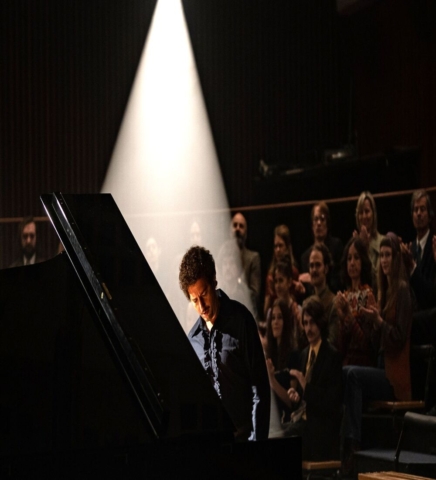
Grant sings and plays the piano inside a mini stage that resembles the outline of a human head. The musician is, quite literally, in George’s mind. The evocative score and lyricism pull the viewer in. Meanwhile, the veil of depression is another undeniably clever element of Chiara Stepehenson’s set design. Stephenson and the Royal Opera House used the method of flocking, which creates an effect of covering everything on stage in grey dust. His world is dim, and movement and the staging convey the heaviness of a queer man’s grief at a time when homosexuality had to be concealed.
Though Watkins avoided watching Tom Ford’s 2009 film adaptation of the novel to escape outside artistic influences, we can see how both directors set out to demonstrate George’s hopelessness. In Ford’s film, the mundane activities flow under the lens of an undersaturated filter, and the flocking of Watkins’s stage similarly presents George’s metaphorical absence in his life. This ballet talks to the audience about grief in body language cues, and brief exhales of lust are the ultimate nod at human nature.
Christopher Wheeldon’s choreography of Like Water For Chocolate
Watkins is not the sole undertaker of the mission of turning a literary piece into a ballet performance. Christopher Wheeldon’s choreography of Laura Esquivel’s 1989 novel Like Water for Chocolate is a beautiful exploration of a forbidden love that takes place on a Mexican ranch.
Unlike Watkins, Wheeldon does not draw on lyrics to elicit emotion. Instead, Joby Talbot’s magical score associates individual instruments with specific characters – Pedro with the guitar, and Tita with the ethereal wind instrument ocarina. Music is famously a significant element of Mexican culture. The intensity of Tita and Pedro’s yearning and battle against societal expectations is brought alive in an expressive, culturally-inspired ballet.
Their romance is full of passion, fighting against the circumstances pushed on them by the firm hand of Tita’s mother, Elena. Mama Elena projects her own romantic repression onto Tita. In love, chemistry is a product of the mind and the body. Through ballet, Wheeldon puts those feelings into, at times, sexy, at times, painful performances.
Amplifying Marginalised Voices
People want to be heard by artists. The need for ballet to evolve with the times is why the telling of contemporary tales is such a crucial cultural phenomenon. The demographic that is looking to attend classics such as ‘The Nutcracker’ is very particular, and the language of such productions may be deemed as a luxury. Therefore, in reimagining untold tales about marginalised groups, ballet takes a new, fresh form.
This was choreographer Iyun Ashani Harrison’s motivation when selecting James Baldwin’s 1956 novella Giovanni’s Room as a subject to reimagine in his dance company Ballet Ashani. Baldwin’s work, much like Isherwood’s, was revolutionary for its time. It dared to shine light on a queer love between two men, and the ugliness that comes with feelings of internalised homophobia.
Ballet allowed Ashani to use theatrical tricks to explore metaphors that linger in Baldwin’s raw storytelling. The world has come far from a time when sexual orientation discrimination was everywhere, and employing ballet to remind us to celebrate societal progress and inclusivity deepens our sense of community.
Stepping Into The Protagonists’ Ballet Shoes
We feel for the characters, want to cry with them, want to love like they love. All of the aforementioned works are similar in their emotional strength. George encapsulates the caging of the LGBTQ+ community at a time when the only way to romantic freedom was hiding. This longing to hold someone who has turned into a quiet memory haunts George as he completes meaningless tasks. The stark movements of the ballerinas show the audience how grief punctures every inch of the human body.
This too rings true for Tita, who conceals her love for Pedro to escape her mother’s wrath. Suppressing something only pours more fuel on the fire; there is a reason plays like Romeo and Juliette have enchanted viewers for centuries. To express something through silent dance is a unique challenge, where the viewer internally builds their own narrative and interpretation. Music and performance art is one of the greatest emotion-inducing mediums. When combined with contemporary literature, it engages the audience intellectually and audio-visually.
Empathy: Mirror Neurons And The Social Brain
Ballet performances, as entertaining as they are, also play a vital role in boosting human empathy. There is a scientific reason why ballet evokes such a powerful emotional response. The mirror neurons in our brains are one of the key roots of empathy. Essentially, they make you mentally mimic visual stimuli. The mind then imagines sharing the feelings the ballet dancers’ passionate manoeuvres convey.
This deepens our relationship to works that have only existed in written form, as movement brings about deeper emotional engagement. That is why, upon seeing Ed Watson’s mechanical flow as George, we will be unable to break free from feeling as if we are living in the protagonist’s sorrow.
Contemporary ballet isn’t just dance: it is an amalgamation of set design, music, choreography, costumes, and the list goes on. The multitude of those layers allows for incredible creativity and experimentation, which brings new audiences to the timeless form that is ballet.
A Single Man is at The Royal Ballet between 8-20 September 2o25, with tickets available Here
Like Water For Chocolate is at The Royal Ballet between 1-4 October 2025, with tickets available Here
If you enjoyed reading New Gen Ballet: Spectacular Literary Voices, then why not read What Is Minimalistic Music? A Formless Yet Powerful Sound?
.Cent Magazine, London; Luxury Mindset
Follow us: