Magic Of Sensory Mingling: Taste The Melody Of Luxurious Champagne
Have you ever noticed that merging multiple senses brings a special kind of pleasure? Music often serves as a common denominator in discussions about this. Ambient sounds that lull the mind into serenity during a massage, congregational song with its togetherness and connection to a higher energy, jazz playing softly as you cook, a glass of red in hand… Experiences are elevated when one medium is combined with another. Sommeliers are fascinated by this phenomenon and have long been interested in the connection between music and taste. Find out about the latest collaboration between Krug Champagne and composer Max Richter, and dive into the Magic Of Sensory Mingling: Luxurious Champagne Meets Musical Flair.
We may well be oblivious to the playlists bars have on as you talk to a friend over a cocktail, and yet music and drinking are the perfect pair. Record bars, pubs that host jazz nights, dive bars that play old school metal, the wine bar with soulful softies … The list goes on. Sound creates atmosphere, and the indulgence of music is then translated into the experience of drinking. The meeting point of the two enhances the taste buds, creating a luxurious sensory explosion.

Combining Taste And Sound
In November 2021, Hong Kong-based ensemble the Up:Strike Project endeavoured to combine music and drink. The guests relished the music of John Cage and Astor Piazzolla, while being offered a selection of Argentinian music-inspired cocktails. Titled ‘Menú Del Día’ (menu of the day), the aim was to let the audience explore music they’d never heard before in the midst of enjoying a drink, and vice versa.
Research suggests that people derive 15 per cent more enjoyment from wine when it’s accompanied by the right kind of music. Indeed, there is a phenomenon of sensation transference in the matter. If a restaurant’s design catches your eye, you are likely more enticed to go in and try the food. Humans have five senses for a reason, and there is excitement in exploring how one may affect the other. Maison Krug Champagne certainly seems to agree.

Maison Krug: Champagne And Music
After the First World War, Joseph Krug II, the third owner of Krug Champagne, put in place the first private music room at the Krug residence in Reims. Now, this tradition lives on in the form of the Krug Music Yurt, where the family welcomes guests.
Music has long been an important element of the Krug vision of luxurious champagne. Maison Krug sees it as an analogy of their craft, where Cellar Master Julie Cavil pinpoints the individual melody of each wine, working to discover the true harmony of champagne. Who would have thought that wine had a sound?
Krug X Max Richter
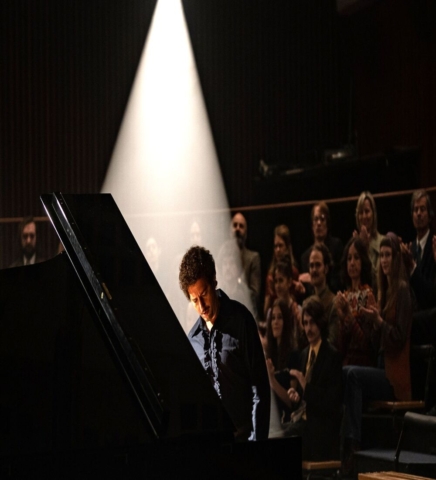
Mixing luxury drinking with modern composing is the latest project from Maison Krug. ‘Every Note Counts’ is an encounter between the genre-defying music of composer and pianist Max Richter and the melody of three champagnes by the house. In response to these three, The Krug Clos d’Ambonnay 2008, The Krug 2008, and The Krug Grande Cuvée 164ème Édition, Richter created three unique pieces: Clarity, Ensemble and Sinfonia.

Words used to describe wines are often synonymous with metaphors defining music because of their shared sensory experience. Adjectives like ‘heavy’, ‘mellow’, ‘harmonious’ or ‘smooth’ are both in the lexicon of melomans and oenophiles. This, therefore, creates a natural space for a composer to describe the melody of champagne.
“Blending so many unique sounds from different years lends a generosity of flavours and aromas that could not be expressed with the wines of just one year.”
Julie Cavil, Krug Cellar Master
And it’s not just the words. Most interestingly, research has shown that music affects the perceived acidity, sweetness, fruitiness, astringency, and length of wine. So there is clearly a direct correlation between the senses.
In creating scores for the three 2008 champagnes, Richter worked closely with Cavil to find where the two met, translating the joy of a cuvée into composing.
Max Richter: From Vineyard To Score
In order to fully explore, Richter visited the vineyard and collected his own impressions of the wines. Exploring the sensations and descriptors as he tasted, the pianist considered how he could intertwine taste with the symbolism of music.

For him, the triptych of the musical arrangements progressed in parallel with the winemaking. Beginning with the solo piece ‘Clarity’, Richter reflected on the purity of a single plot. Then came the chamber composition ‘Ensemble’, which evoked for him the weather conditions that brought about the excellent plot. Finally, ‘Sinfonia’ responded to the blending of 127 wines from 11 years. The wines amalgamate into a singular, cohesive ‘symphony’.
Experimental Music And Its Adaptability
The beauty of experimental classical music, in which Max Richter is an expert, is the adaptability and the way it responds to various stimuli.
So whilst music, as research has suggested, is capable of amplifying the taste of a wine and highlighting certain flavours, perhaps what is most meaningful is the interrelation between the two, and the transfer of pleasure from one to another.
Find out more about the collaboration of Max Richter and Maison Krug Here.
If you enjoyed reading Magic Of Sensory Mingling: Taste The Melody Of Luxurious Champagne, why not read The Dirty Mud To Beautiful Muse: Formless Clay In Art?
.Cent Magazine, London; Luxury Mindset
Follow us: