Woven: Man Booker Storytellers
The art of weaving words and imagination together to make a story is a tradition as ancient as humanity itself. Storytelling forms community. With words (spoken, written), we share, we reveal, we create.
Established in 1969, The Man Booker Prize is dedicated to the promotion and celebration of the finest storytelling in the English language. Each of these stories is singular and distinctive; but, fundamentally, these are stories about what it means to be alive and human. Like human existence, they are painful, funny, terrifying, devastating, exciting, terrible, exhausting and infinitely beautiful.
Milkman, Anna Burns

This year’s winner of the prestigious and influential award is Anna Burns with her startlingly unique Milkman.
‘The day Somebody McSomebody put a gun to my breast and called me a cat and threatened to shoot me was the same day the milkman died’.
Burns’ novel, written from the perspective of an 18-year-old girl, takes place in an unnamed city during the Northern Ireland conflict. Our narrator refers to herself only as ‘Middle sister’ and tells her story according to internal thought-processes, observations, narrative digressions and labyrinthine trails of logic. Although Burns places her protagonist at the heart of the Irish Troubles and socio-political unrest, she does not deal directly with state atrocities and political brutality; the threat which pervades the novel exists in the more surreal and sinister guise of rumours, the unsaid, the not-there, the mis-seen and mis-heard. Over the whole lingers a sustained anxiety about self-preservation against prying eyes, abuses of power, sexual harassment and community gossip.
Burns’ claustrophobic, darkly comic prose doesn’t give us a chance to breathe. We are propelled through her bewildering and nightmarish – and yet disturbingly real and relevant – world with a relentless momentum which is both exhausting and compelling and leaves us reeling. The Man Booker judges’ conferring of the prize on this experimental novel marks a step away from old-school standards of literary expression and endorses surprising, unconventional and alternative voices in fiction.
Everything Under, Daisy Johnson
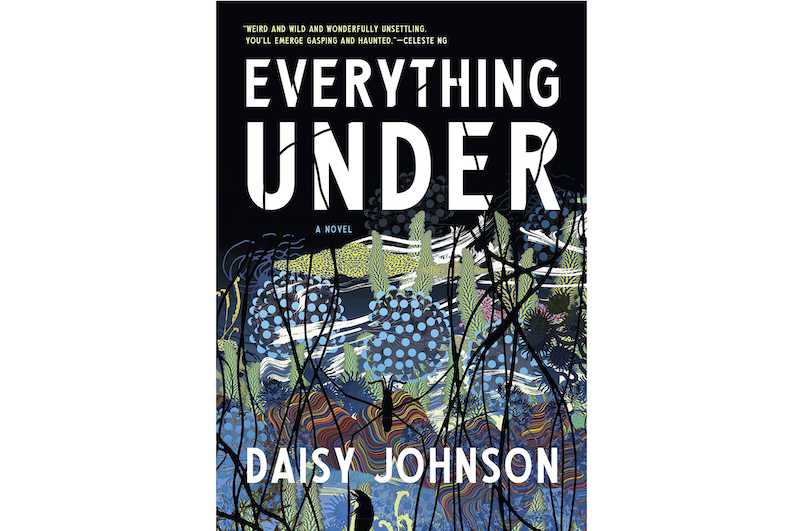
‘The places we are born come back to us. They disguise themselves as words, memory loss, nightmares. They are the way we sometimes wake with a pressure on our chests that is animal-like or turn on a light and see someone we’d thought was long gone standing there looking at us’.
In Daisy Johnson’s magical-realist tale of womanhood, mother-daughter relationships, gender-transitions, childhood and memory, Gretel, a lexicographer, is reunited with her mother who abandoned her to foster-care as a teenager. Learning how to deal with her now elderly mother’s dementia and reconnect with her past, Gretel is forced to confront questions that she has kept long-buried – what happened during her childhood on a canal boat? who was the strange, awkward, sad-eyed boy who stayed with her and mother one winter? and what is the menacing presence that still lingers like a flicker at the edge of her vision – the creature in the water, the shadowy monster? Johnson’s novel runs from beginning to end like the swirling water of the canal that flows through it. The mystical and folkloric are bound up with issues of individual identity and interpersonal familial relationships, all executed with an astonishing lyricism and with brilliantly-observed characterisation.
The Mars Room, Rachel Kushner

‘I don’t plan on living a long life. Or a short life, necessarily, I have no plans at all. The thing is you keep existing whether you have a plan to do so or not, until you don’t exist, and then your plans are meaningless’.
At Stanville Women’s Correctional Facility in California, Romy Hall, a 29-year-old single mother, is at the beginning of two consecutive life sentences – punishment for killing her stalker. In Rachel Kushner’s stark, unembellished and uncompromising depiction of what it means to be underprivileged and female in the United States, the fiction of a great, free and prosperous America is torn aside to reveal the reality lived by those on society’s margins. Her protagonist grew up with a painkiller-addicted mother, was raped at 11 years old and later became addicted to drugs, making money as a sex worker and working in a strip club called The Mars Room. Kushner’s novel is thoroughly researched, and she treats her subject matter with great astuteness, without flippancy or sensationalism. Her characters are distinctive, noisy and defiant, her wit is sharp and biting and her novel represents a female voice unafraid of delivering a devastating and authentic account of the way things are.
Washington Black, Esi Edugyan

‘I have walked this earth for eighteen years. I am a Freeman now in possession of my own person’.
Washington Black, an 11-year-old slave working on a Barbados sugar plantation, is selected by the new plantation-owner, Christopher ‘Titch’ Wilde, a naturalist, explorer and engineer, to be his personal servant. In Titch’s hydrogen balloon, Washington begins his “strange second life”, leaving the cane plantations far behind and below and voyaging to Virginia, Nova Scotia, the Arctic, Amsterdam and London. While travelling, he cultivates his skills in draughtsmanship and pursues his interest in marine zoology. Edugyan’s novel is a broad, full and sincere tribute to the mind, intelligence and the richness of human thought, framed as a quest for liberty and knowledge. Shocking occurrences of cruelty are offset by moments of human warmth and genuine compassion between characters. A grand tour of the world in pursuit of that to which we are all entitled: freedom.
The Overstory, Richard Powers

‘People have no idea what time is. They think it’s a line, spinning out from three seconds behind them, then vanishing just as fast into the three seconds of fog just ahead. They can’t see that time is one spreading ring wrapped around another, outward and outward until the thinnest skin of Now depends for its being on the enormous mass of everything that has already died’.
The story of nature is more vast, rich and complex than we, wrapped up in our anthropocentric history, can possibly fathom. Richard Powers’ novel is an ecological masterpiece, a mythic, fable-like rendering of the history of trees: their ancestry, their interconnectedness, their cycles, their wisdom, magnificence and immensity. Across his four sections – Roots, Trunk, Crown, Seeds – Powers considers human lifetimes, families, communities, individuals and their ancestral connectedness, alongside the overstory of the natural world. His nine narratives are woven together to create an epic chorus of human and arboreal voices.
The Long Take, Robin Robertson

‘The trees by the East River have things
snagged in their branches: clothes,
fish-crates, ropes and sacks, bodies sometimes
people say, trapped there by the tides, the ice.
It’s the wire. They’re caught deep in barbed wire, and can’t get free. Can’t get out of the water and onto the beach. They’re waving their arms and screaming but the landing craft just goes over them, the propellers just cutting them apart’.
Halfway between poetry and prose, littered with photographs, Robin Robertson’s noir verse novel refuses to conform to any particular literary form or genre. His story is that of the action and aftermath of World War II, his protagonist a D-Day veteran suffering from post-traumatic stress disorder. Walker’s experiences as a soldier prevent him from returning to his rural home in Nova Scotia – instead he travels between New York, Los Angeles and San Francisco in restless search of anonymity, forgetfulness and rehabilitation into normal life. Robertson’s words and images paint a powerful picture of a man struggling to regain a sense of the world and of himself in an America which is, itself, decaying, corrupt and brutal. His immersive poetic voice and the novel’s photographic details are testament to the power of language and the importance and responsibility of witness.
These books are tied together by their craftsmanship and timelessness. They are their own worlds, contain their own characters, spin their own tales, and yet the stories they tell are intensely, fundamentally human. In recognition of the necessity of literature that speaks to us of human experience from original perspectives, The Man Booker Prize has constructed its monument to the storytellers, the wordsmiths, the dream-weavers.
Milkman, Anna Burns
Everything Under, Daisy Johnson
The Mars Room, Rachel Kushner
Washington Black, Esi Edugyan
The Overstory, Richard Powers
The Long Take, Robin Robertson
Follow us: