Steorra: Aesop’s New Perfume That Captures the Scent of Myth
A scent made from a constellation of ingredients; a near-citrus spark that burns into warmth. The new Aesop Perfume “Above Us, Steorra Eau de Parfum” for October 2025 reaches beyond the earth and into myth and legend, with each perfume ingredient having a unique and rich history. From Amber tears and mystical creatures, to star-crossed lovers and gifts from kings, these ingredients carry stories from the earth to the heavens, and form a celestial archive in the new fragrance by Aesop. Read Steorra: Aesop’s New Perfume That Captures the Scent of Myth to find out more about these fascinating stories.
Image on left hand side taken by Jason Yates.
Above us, Steorra EDP Aesop 2025
Aesop’s new Eau de Parfum, “Above us, Steorra”, has a celestial description, as the perfume is inspired by the glorious night sky. The ingredients of this new perfume are like a meeting of individual stars, and the overall scent is a constellation of “near-citrus spice”, with an Amber and a woody aroma.
Top Notes Perfume
Top notes of Cardamom, Bergamot and Elemi open up the perfume with a soft spice and bright ‘light’, with a whisper of pine. The Elemi creates a fresh first breath, like a whimsical breeze.
The Heart Perfume
The middle notes are a mixture of Frankincense, Labdanum and Cypriol Heart. The Frankincense and Labdanum, with a hint of the Vanilla Bean base note, create the imagined scented accord of Amber. Cypriol Heart grounds the scent, as the soft spice of Cardamom melds in the opening notes to a glimmering warmth in the base.
The base notes perfume.
Vanilla Bean, Cinnamon and Cypriol Heart are the base notes of the fragrance; a sweet and warm facet, emphasised by the Cinnamon with an addition of another warm spice. An earthy tone is added to the base by the Cypriol Heart, making sure the fragrance is a cosmic journey of smell from the stars to soil.

Dried bark strips
Perfume Ingredients
The ingredients individually are somewhat mythical, magical even, linking the perfume to the stars. Each ingredient has a story, from Ancient Greece to Biblical tales, and many of these notes have been with us as humans since the beginning of time.
Frankincense
Frankincense is most commonly associated with the story of the birth of baby Jesus; the three wise men followed a star, a celestial event that guided them to Jesus, and gave gifts of Gold, Frankincense and Myrrh. However, Frankincense and Myrrh as a combination had been around long before the baby Jesus was said to have been born.
In the Old Testament, around the 10th century BCE, there was a secret recipe for incense, believed to contain Frankincense and Myrrh, among other ingredients. It was a popular recipe used during worship and passed down through generations.

Adoration of the Magi, Oil on oak wood, Gerard David (c. 1515)
Mythical Creatures
Cinnamon was used for embalming mummies, rituals and perfumes in Ancient Egypt. But that’s not the most interesting story about Cinnamon. In fact, around 2,500 years ago, just under 500 years before the end of the Ancient Egyptian empire, throughout the Arabian Peninsula, Arab traders told stories of a terrifying beast.
The beast was known as the ‘Cinnamologus’. They made their nests out of cinnamon, and it was said that, in order to get the cinnamon sticks, the traders would bait the beasts and break their nests. This meant the traders could collect cinnamon sticks.
Now, there is no evidence that such a creature ever existed, and the traders probably spread the tale of ‘The Cinnamologous’ to ward off competitors from attempting to find the source of the spice, but it’s always fun to imagine that thousands of years ago, giant mystical birds flying around collecting an assortment of spices.
Medusa and Poseidon
Labdanum is a resin that comes from flowery plants named Cistus Creticus shrubs, also known as Rockrose, which grows in many places around the Mediterranean Sea; the earliest mentions of its harvest come from Crete.

Medusa, Oil on canvas mounted on wood, Caravaggio (c.1597)
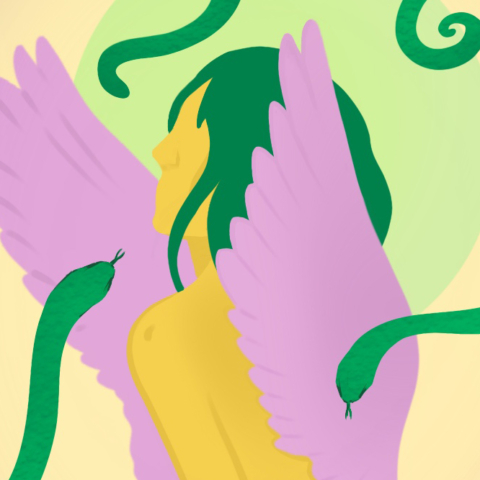
Labdanum is associated with the iconic Gorgon everyone knows from Greek mythology, Medusa. According to some, the story of Medusa and Poseidon is one of seduction. Before Medusa was turned into a monster, she was seduced by Poseidon, God of the sea, in a meadow full of Rockrose flowers, making Labdanum a resin of ‘sexuality and water’.
After this, the goddess Athena transformed Medusa. This story meant that over centuries, labdanum was imbued with a deep and sensual symbolism and linked heavily to mythology and gods.
Lakshmi Goddess
First, Ancient Greece, and now Ancient India. Thanks to one legend, which says Lakshmi blessed the mountains with Cardamom pods, and so the spice is seen as a gift from the gods themselves.
Lakshmi is the goddess of wealth and prosperity. By blessing the region, believed to be the Western Ghats (a mountain range where spice is grown to this day), Lakshmi ensured the area’s fertility and abundance.
Amber Gemstone
Surprisingly, a multitude of stories connect amber with tears. Greek Mythology has a story about Helios, the God of the sun, and his son Phaethon.
Phaethon rode his father’s chariot. Struck down by Zeus, the king of the Gods, he died, and his sisters cried and cried for their brother’s death. It was said their tears formed droplets of Amber.
Fast forward to the Viking age, around 790-1100 CE, the Norse goddess Freyja is primarily associated with love, beauty, fertility and war, and is known for riding in a chariot pulled by cats. Freyja travelled through the world seeking her lost husband, Odr, and weeping all the while. Where her tears fell on soil, they turned to gold, but if they fell into the sea, they turned into Amber.
Where is Vanilla from?
We usually associate Vanilla with childhood memories, like having an ice cream on a hot beach day during the summer holiday.

Dried Vanilla Beans
In terms of smell and perfumes, Vanilla is a rich and creamy base note which often adds a soft and sophisticated quality to a scent. But did you know that the origins of Vanilla stem from a story of star-crossed lovers from the indigenous Totonac people of Mexico?
The Totonac people reside in a coastal region of what is now Veracruz. In legend, there is a story that tells of a Princess Xanax, daughter of a King, who had a forbidden love with a mortal man. The lovers were eventually sacrificed by the King.
When the lovers’ hearts were eventually brought together, something magical happened. A shrub with an orchid of yellow petals sprang up, from which pods hung. A rich aroma came from the dried pods, and Vanilla was declared a sacred plant and an object of worship.
Each Ingredient has a history and individual meaning, and with each note, “Above Us, Steorra” captures the cosmos in a bottle. It not only smells heavenly, but also stems from Ancient stories about the sky and celestial beings.
Rooted in myth, biblical stories, and legend, the ingredients come together to form a magical scent that shines as bright as a constellation.
If you enjoyed reading Steorra: Aesop’s New Perfume That Captures the Scent of Myth, why not try reading The History of Blonde: How Blonde Lost it’s Halo?
.Cent Magazine, London; Luxury Mindset
Follow us: