Lost in the Awesome Outside: Beautiful Landscape as a Character In Film
For June’s theme, ‘Outside’, we dive into the profound, often overwhelming spaces where cinema stops merely recording the world and begins to feel it. Far from being a mere backdrop, a postcard frame, or a simple aesthetic showcase, the outer space in auteur cinema becomes the central protagonist of the narrative, a shifting, breathing entity that dictates its own laws, shapes souls, and imposes its unique, uncompromising rhythm on lost characters. It is within this emotional dialectic of wandering and immensity that the landscape breaks free from its passivity to truly claim the screen, turning geography into raw human feeling. Find out some of the best examples here in Lost in the Awesome Outside: Beautiful Landscape as a Character In Film
Landscape Cinema
The scenery becomes the added character in a film when a landscape or environment becomes an active, driving force in the narrative rather than just a static backdrop; Commonly referred to as environmental storytelling or landscape-driven cinema. It can be seen not just in films about the environment but also in Westerns, via Folk Horror, and even Slow Cinema. In this style of filmmaking, the setting dictates the mood, influences character decisions, and essentially acts as a primary antagonist, protagonist, or catalyst. Here are a few classics
Lawrence of Arabia
To open a reflection on the physical and psychological grandeur of open spaces without evoking the cinematic canvas of David Lean would be a contradiction in terms. In his timeless masterpiece ‘Lawrence of Arabia’, the Nefoud Desert is never just sand and heat; it establishes itself as a psychological mirror reflecting the terrifying heights of human ambition and madness. Lean’s sweeping wide shots, with their crushing, infinite horizontality, initially reduce man to a mere speck of dust, a fragile silhouette swallowed by the void. Yet, it is precisely within this absolute, scorching emptiness that the landscape becomes the crucible for a mystical reinvention. The desert possesses a raw, haunting voice, a suffocating heat, and a quiet cruelty that dictate every geopolitical choice and intimate breakdown, transforming what could have been a standard historical epic into an immense, deeply emotional psychological drift.
Stalker Movie
This capacity of the setting to converse with the invisible and tap into our deepest existential anxieties finds its most radical, mystical expression in the work of Andrei Tarkovsky. In ‘Stalker’, nature is not indifferent; it possesses a living, shifting, and deeply eerie soul. ‘The Zone’ is a post-industrial landscape reclaimed by a mysterious, silent force, a territory that alters its face according to the deepest secrets, fears, and intentions of those who dare to cross it. It punishes human arrogance and rewards a quiet, broken deference. Through slow, hypnotic tracking shots that linger on moss, water, and decaying metal, combined with a deeply organic soundscape, Tarkovsky captures a profoundly philosophical and emotional nature. The landscape no longer accompanies the journey: it is the journey itself, a sacred, unpredictable character that can only be understood if one agrees to surrender to it entirely, letting its silence wash over the psyche.
Paris, Texas
With Wim Wenders, the outside location shifts into the heartbreaking hues of a glowing, melancholic American loneliness. From the very opening frames of Paris, Texas, the landscape establishes itself as the emotional cornerstone of the entire film. We watch Travis emerge from the vast, unforgiving Mojave Desert, walking entirely alone among the towering red rocks under a blue sky that feels almost bruising in its intensity. Robby Müller’s legendary cinematography makes the abandoned petrol stations, neon-lit motels, suspended freeways, and arid immensities vibrate in unison with the character’s profound silence and emotional drift. The Texan landscape is not just a location; it is the physical materialisation of the vast distance and aching incommunicability that separate human beings who love each other but can no longer reach across the void.
Le Signe du Lion
This emotional confrontation with the exterior is not exclusively synonymous with wild nature or endless desert plains; it can also manifest in the suffocating claustrophobia of an empty city. In his debut feature Le Signe du Lion (The Sign of Leo), Éric Rohmer delivers a brilliant, devastating reinterpretation of the urban landscape as an antagonistic force. During a scorching, breathless month of August, Paris empties entirely of its inhabitants, leaving behind nothing but a stark, heavy decor of blinding stone, burning asphalt, and indifferent monuments. For the protagonist, who is undergoing a complete financial and social downfall, the famously romantic capital transforms into a hostile, sun-bleached . Captured with a relentless documentary rigour, the City of Light becomes a literal desert of summer loneliness, showing how an urban exterior can isolate a human soul just as fiercely as the open seas.
The Golden Dream
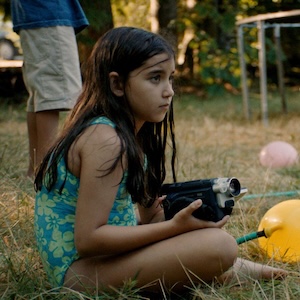
This profound immersion into a territory can be anchored in a raw, urgent social reality where geography stands as an active witness and accomplice to the tragedies of our century. This is precisely the heartbreaking case in the Mexican gem The Golden Dream (La jaula de oro) by Diego Quemada-Díez, which follows the perilous journey of young migrants riding the roof of the cargo train known as ‘La Bestia’ towards the United States. Here, the lush nature of Central America and the cold, metallic tracks form a dual character: one that is breathtakingly beautiful in its visual texture, yet utterly deadly in its physical violence. The landscape is never romanticised to comfort the viewer; it relentlessly embodies both the geographical and human barriers of our world, moving from a symbol of hope to an active, hostile force that tests the very limits of survival and youth.
Into The Wild
The outside, for Into The Wild, takes the form of a romantic utopia that slowly, heartbreakingly morphs into an unyielding trap. By venturing deep into the frozen veins of the Alaskan wilderness, Christopher McCandless is not merely fleeing the suffocating constraints of modern consumer society; he is seeking a primal, spiritual fusion with the Earth. Sean Penn’s camera initially captures these endless vistas of towering mountains, rushing rivers, and infinite pine forests as spaces of absolute liberation and poetic purity. Yet, as the seasons shift, this monumental character of flora and stone reveals a crushing, terrifying indifference to human existence. The iconic abandoned bus, parked in the middle of nowhere, ceases to be a shelter and becomes the arena for a tragic, intimate face-off. It exposes a nature that is devastatingly beautiful to look at, but utterly unforgiving to the touch, proving that the wild does not care to love us back.
Silence
For Silence by Martin Scorsese, the immense visual austerity of the landscape of 17th-century Japan stands as a stark, active accomplice to the agonising doubt and crisis of faith shaking the Jesuit missionaries. The setting is perpetually misty, damp, rugged, and almost spectral, a terrain that feels as though it is actively hiding the divine. The heavy ocean waves crashing relentlessly against the jagged, rocky shores of Nagasaki are far from mere background noise; they become the very instrument of martyrdom, a deafening, cyclical force that rhythms the slow torture of the believers. This harsh, fog-shrouded environment organically embodies the crushing silence of God, throwing up an insurmountable physical and spiritual wall against the desperate prayers of men, where the mud and the mist swallow every cry for salvation.
Nomadland
The landscape shifts into a vast, modern frontier of nomadic survival, where the landscape becomes both a sanctuary and a quiet mirror for the displaced human soul. Through Chloé Zhao’s lens, the endless open highways, quiet misty mornings, and blood-red sunsets of the American West are far from a postcard backdrop; they represent a radical way of life. The vast desert plains and rugged badlands do not merely frame Fern’s van; they dictate her daily rhythm, offering a raw, melancholic freedom that contrasts sharply with the rigid constraints of corporate society. Immersed in natural golden light, this immense geographic expanse acts as a silent companion to grief and resilience, a space so beautifully infinite that it swallows individual loneliness, transforming the wilderness into a harsh but deeply healing home.
Midnight in Paris
This dialogue with the exterior proves that a landscape does not need to be wild to become a sentient, driving character; it can manifest within the romantic, historical architecture of an urban myth. Here, the picturesque riverside streets, stone bridges, and rain-slicked cobblestones of Paris do not simply serve as a scenic tour, they act as a literal portal through time. The city itself functions as an enchanting, nostalgic protagonist that actively manipulates the narrative, luring Gil into its nocturnal maze to challenge his disillusionment with the present. Bathed in a warm, amber glow, this cinematic Paris is a living museum that breathes its own poetic laws, proving that an urban landscape can sculpt a character’s desires and romantic obsessions just as fiercely as any untamed horizon.
The Lord of the Rings Trilogy
The outside location reaches its ultimate, epic scale when geography itself is weaponized as the supreme moral arbiter of a world. By utilizing the sweeping panoramas of New Zealand’s Southern Alps and remote, untouched national parks, the setting transcends fiction to capture the ancient majesty of Middle-earth. These landscapes, ranging from the suffocating, ash-choked jagged rocks of Mordor to the rolling, verdant purity of the Shire, are active forces in the narrative. The mountains resist the travellers with freezing winds, the ancient forests watch with living eyes, and the vast plains test the literal limits of physical endurance. It is a monumental environment that actively shapes the souls of its inhabitants, where the terrain itself fights alongside the characters, embodying the eternal struggle between corruption and purity.
Out of Africa
In this sweeping masterpiece, the landscape of Kenya establishes itself as the true, untamable love interest of the entire film, a presence far larger than any human romance. The vast, sun-baked savannahs, acacia-dotted horizons, and soaring aerial views of the Rift Valley are not merely exotic scenery; they form a fierce, breathing entity that refuses to be possessed or colonized. The African terrain imposes its own wild, unpredictable laws on Karen Blixen, breaking down her aristocratic shields through torrential rains, predatory wildlife, and a golden, dusty heat. This infinite landscape becomes the physical materialization of absolute freedom and devastating loss, a character so monumental that it permanently redefines the souls of those who dare to love it, leaving an indelible imprint that lingers long after the plains have vanished from view.
The Motorcycle Diaries
The exterior here serves as the ultimate, visceral catalyst for a political and human awakening, where geography directly rewires the human conscience. As we follow a young Ernesto Guevara across the Latin American continent, the landscape ceases to be a travel log and becomes the raw textbook of a revolution. The mist-shrouded, freezing peaks of the Andes, the vast, suffocating dust of the Atacama Desert, and the ancient, spiritual ruins of Machu Picchu are active witnesses to the struggles of the land. Walter Salles’ camera captures a territory that bleeds and breathes alongside its people; its rugged terrain and harsh environments physically test, bruise, and ultimately reshape the travelers. The continent is a colossal, shifting protagonist that moves through the characters, proving that to truly traverse a landscape is to let its geography shatter your illusions and redefine your destiny.
Whether it takes the form of an infinite sand dune, a mystical post-apocalyptic plain, or a Parisian street crushed by a summer sun, the cinematographic landscape, when treated with the radicality of auteur cinema, definitively sheds its passivity. It feels, it resists, it speaks. For the filmmakers of wandering, the outside is never merely what we look at through a window, it is that which moves through us, challenges our inner architecture, and ultimately, leaves us permanently transformed.
For more information about Lawrence of Arabia, please visit here
For more information about Stalker, please visit here
For more information about Paris, Texas, please visit here
Fore more information about Le Signe Du Lion, please visit here
Fore more information about La Jaula de Oro, please visit here
Fore more information about Into the Wild, please visit here
Fore more information about Silence, please visit here
.Cent Magazine, London. Luxury Mindset
Follow us: